Intumescent Fire Protection Coating
Certified intumescent fire protection coating in Accra, Ghana — passive fire protection for structural steel specified to rated fire-resistance periods under BS 476 and EN 13501, with per-member thickness calculated and verified, for institutional, commercial, and industrial buildings. City Painting Ghana, since 1972.
Intumescent fire protection coating is a thin reactive coating that, under fire, swells into an insulating char and holds structural steel below its critical failure temperature for a rated period. City Painting Ghana has specified and applied certified intumescent systems across Accra, Kumasi, and Tema since 1972, calculating the thickness per steel member and documenting every measurement.
Why Intumescent Fire Protection Matters in Ghana’s Conditions
Intumescent coating is not decoration — it is a life-safety system. Under fire, the coating reacts and expands into an insulating char that holds the temperature of the structural steel below its critical failure point for a defined period, buying the time on which evacuation and fire-service intervention depend. Across Accra’s growing stock of steel-framed institutional, commercial, and industrial buildings, exposed steel left unprotected can lose its load-bearing strength in minutes once a fire takes hold. Specified wrong, applied too thin, or undocumented, intumescent provides a false assurance that fails exactly when it is needed.
We treat intumescent as the certified life-safety system it is — specifying the product to the required fire-resistance rating and steel section, applying it to the manufacturer’s certified thickness, and verifying and documenting every measurement so the protection is evidenced, not assumed, for the buildings and the people who depend on it.
Intumescent Fire Protection Systems We Offer in Accra
Structural-Steel Intumescent Coating
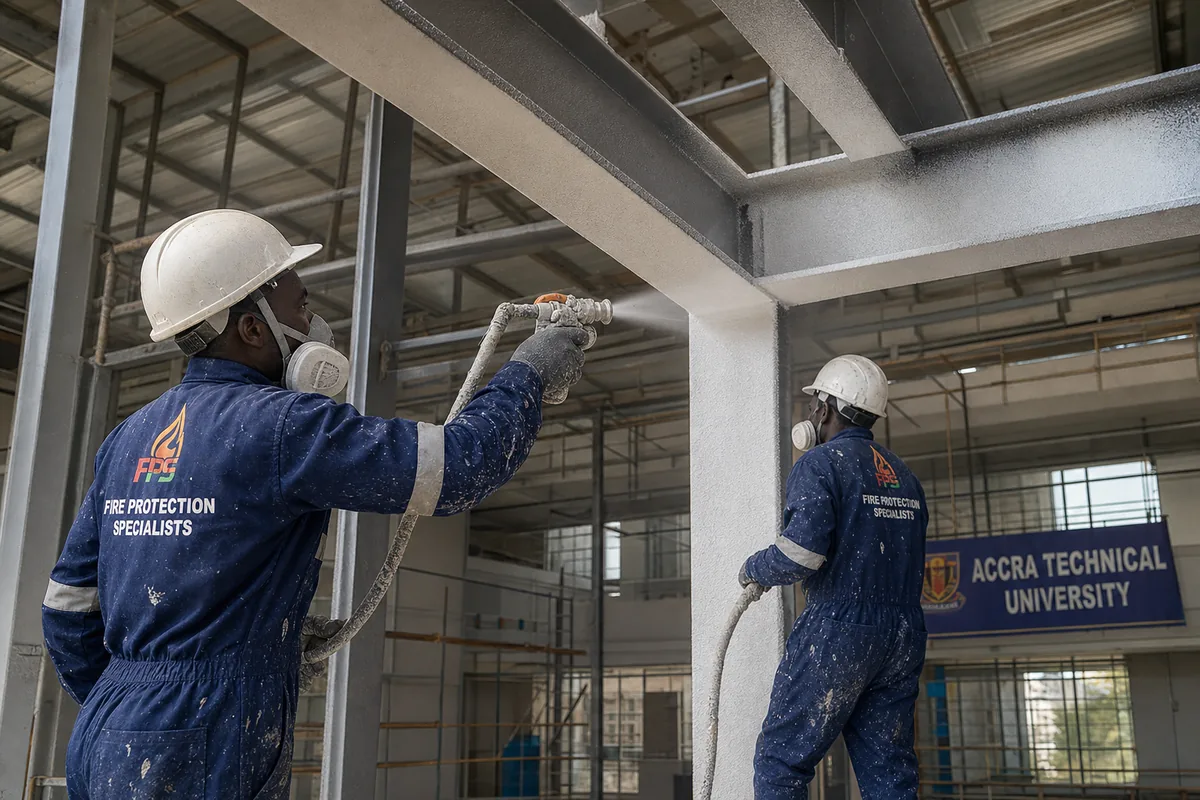
The core service: exposed beams, columns, and frames are assessed section by section, the certified thickness calculated for each member’s rating and section factor, and the intumescent applied and verified to the manufacturer’s loading tables. This keeps the steel visible while delivering the rated fire-resistance period the fire strategy specifies.
Refurbishment Fire-Protection Upgrades
Existing exposed steel is brought up to a specified fire-resistance rating as part of a wider compliance programme, coordinated around occupied operation. Older buildings whose fire strategy has been re-assessed often need their steel upgraded to current rated periods without disrupting the tenants below.
Certified Primer & Topcoat Systems
Intumescent only performs as part of a certified system: a corrosion-protective primer as the base and a compatible topcoat where environmental exposure requires it. Near Accra and Tema’s coastal, humid conditions, the right primer and sealing topcoat protect both the steel and the intumescent layer between fires.
Applications Across Ghana
- Exposed structural steel frames, beams, and columns requiring a rated fire-resistance period in Airport City and the Accra commercial corridor
- Institutional and civic buildings under life-safety compliance — hospitals, schools, and public offices
- Commercial and office structures with exposed architectural steel in occupied or public areas
- Industrial and warehousing steelwork in Tema and Spintex requiring passive fire protection
- New-build and refurbishment steel where the fire strategy specifies intumescent protection
How We Apply Intumescent Fire Protection
- Fire-resistance specification — we take the fire engineer’s rated period and critical temperature for each section as the basis, because nothing is applied without a defined target.
- Per-member thickness calculation — the dry-film thickness is derived from certified loading tables against each member’s Hp/A section factor, since there is no single thickness.
- Steel preparation & priming — steel is graded to ISO 8501 and the specified corrosion-protective primer applied as the certified base.
- Application, verification & certification — the intumescent is applied in controlled coats, wet- and dry-film thickness measured to ISO 2808 per member, topcoat sealed where required, and every measurement documented.
Comparing Fire Protection Methods
| Method | How it works | Best for | Appearance |
|---|---|---|---|
| Intumescent coating | Swells into insulating char under fire | Exposed architectural steel, complex sections | Follows steel profile, stays visible |
| Board protection | Rigid boards boxed around the steel | Hidden steel where appearance is irrelevant | Boxed, hides the steel |
| Cementitious spray | Thick sprayed mineral layer | Heavy industrial steel, high ratings | Rough, concealed steel |
| Off-site intumescent | Coated before delivery to site | Programme certainty on new builds | Follows steel profile |
What Affects the Cost in Accra
- The rated fire-resistance period required (30, 60, 90, or 120 minutes) and the certified thickness it drives
- The section factor (Hp/A) of each member — slender sections need more coating
- The quantity, accessibility, and complexity of the steelwork
- Surface preparation, priming, and any topcoat the exposure requires
- Whether the work is new-build, off-site, or occupied-refurbishment
Every quote follows a free on-site survey and a review of the fire strategy — no fixed price is given before the steelwork and rating are assessed.
Areas We Serve
City Painting Ghana applies intumescent fire protection coating across Greater Accra — East Legon, Airport Residential, Cantonments, Labone, Roman Ridge, Dzorwulu, Trasacco, Spintex, Osu, and Tema — as well as Kumasi and Takoradi.
Related Services
- Specialty Industrial Coating — abrasion, chemical, and performance systems for industrial steel
- Waterproofing & Protective Coatings — roof, wall, and wet-area membranes
- Commercial Interior Painting — durable, low-odour interior finishes
Frequently Asked Questions
When is intumescent fire coating required on a building in Ghana? It is required where a fire strategy or building-control specification calls for exposed structural steel — beams, columns, and frames — to hold a rated fire-resistance period, typically in institutional, commercial, and industrial buildings across Accra. The fire engineer sets the rating; we apply and certify the coating to it.
What is the difference between intumescent coating and board fire protection? Intumescent coating is a thin paint-like layer that swells into an insulating char under fire and follows the shape of the steel, keeping it visible; board protection is rigid boards boxed around the steel. Intumescent suits exposed architectural steel and complex sections; boards suit hidden steel where appearance does not matter.
How thick does intumescent coating need to be? There is no single thickness. The dry-film thickness is calculated per steel member from the manufacturer’s certified loading tables, based on its section factor (Hp/A) and the required rating, so a slender column needs more coating than a heavy beam for the same period. We measure every member to verify it.
How is intumescent fire protection certified in Accra? Each member is measured for wet- and dry-film thickness to ISO 2808 against its calculated requirement, recorded member by member, and issued as a documentation trail the fire engineer, building-control, and insurer can audit — so the installed protection is evidenced to its rated period, not assumed.