The problem
Corporate occupiers need large interiors repainted to a fixed handover date — without surrendering finish quality or losing working days to drying and odour.
Our approach
Fast-Track Interior Rollout
Programme-managed fast-track interior repainting by City Painting Ghana — multi-crew sequencing, rapid-recoat low-VOC systems, and documented QC that hits a fixed corporate handover date.
The Challenge
Corporate fit-out and refresh programmes run to dates that do not move. A floor handed back to an incoming tenant, a head office reopening after a refit, or a hotel returning rooms to inventory all carry a fixed deadline behind which revenue, lease terms, or occupancy targets sit. The interior has to be repainted to that date at full finish quality — and most of the time the building is still partly occupied, so the work has to happen without forcing staff out or leaving usable space unavailable for longer than the programme allows.
The pressures compound. A single-crew decorating approach cannot move a large floorplate fast enough. Pushing dry times to recover the schedule risks a finish that fails inspection. Conventional solvent-heavy systems leave odour that keeps a space out of use long after the paint is touch-dry. Without sequencing discipline, the result is a programme that slips, a handover that misses its date, or a finish that has to be reworked — each of which a corporate occupier measures directly in cost.
The City Painting Ghana Solution
City Painting Ghana runs interior rollouts as a sequenced programme rather than a paint job scaled up. Each engagement opens with a survey that maps the floorplate into zones, records substrate condition and existing-coating compatibility, and fixes the critical path back from the handover date so the crew count, shift pattern, and material lead times are sized to the deadline before work begins.
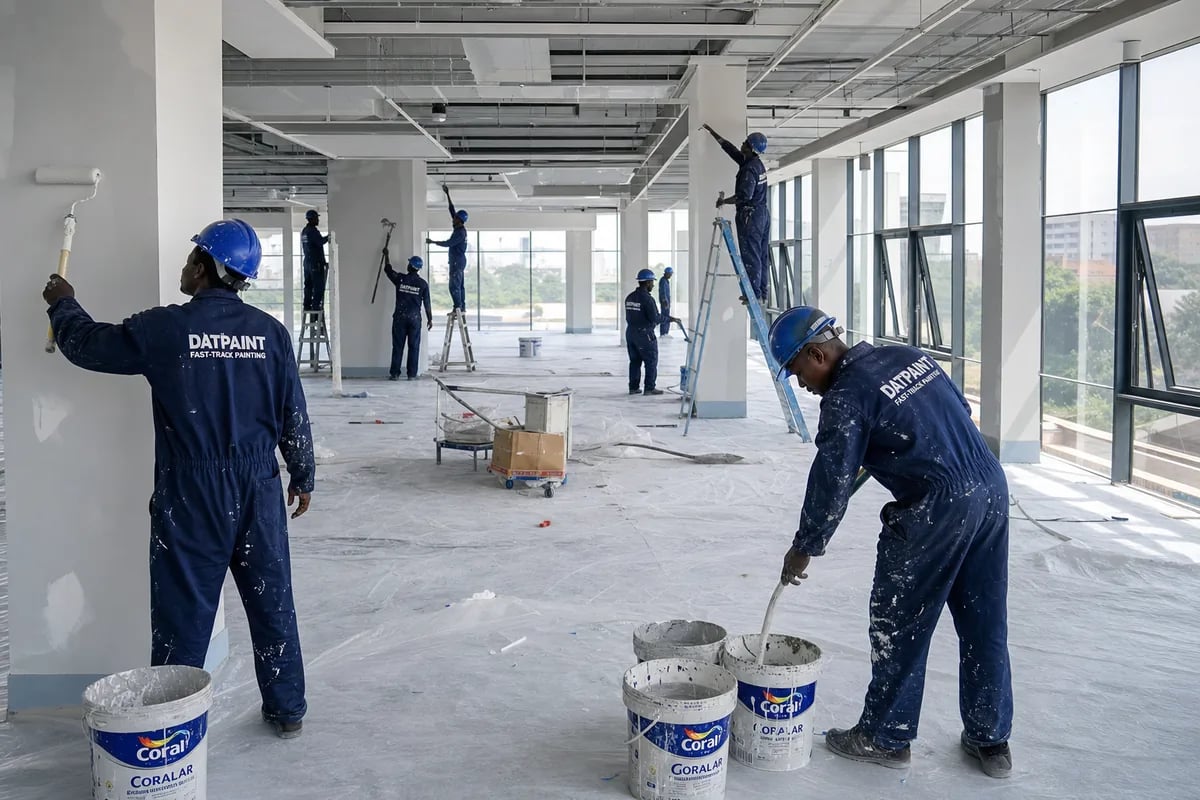
Delivery uses multiple crews working zones in parallel, sequenced so that preparation, base, and finish coats progress as a continuous front rather than a single team moving room to room. Low-VOC, rapid-recoat systems are specified so coats can follow one another inside the working window and spaces return to use quickly and without lingering odour — the discipline that lets occupied buildings stay in service alongside the works. Where the programme spans several floors or properties, one specification and one reporting framework hold the finish consistent across the whole rollout.
Documentation & Process Specification
Every rollout is delivered against a written record: a pre-works survey and zone map; surface preparation graded to ISO 8501; a system specification with batch-controlled colour; dry-film thickness verified to ISO 2808 at finish; and stage QC sign-off through preparation, base, and finish coats per zone. Materials are specified as low-odour, low-VOC systems so occupied areas can be reoccupied safely on schedule. Programme status is reported against the critical path so the client’s facilities and project teams can see the handover date being held, zone by zone, rather than taking it on assurance.
Typical Engagement Profile
These engagements typically run as a single large floorplate turned around inside a tight window, a head-office refresh phased around continuing occupation, or a multi-floor corporate fit-out sequenced to a staged handover. They involve close coordination with the project manager, the incoming occupier or facilities function, and the building’s access and security arrangements — the kind of date-driven, continuity-first delivery City Painting Ghana has run across Accra, Kumasi, and Tema since 1972.
Outcomes
- A fixed corporate handover date met without compromising finish quality
- Occupied space kept usable through low-VOC, rapid-recoat working
- A consistent finish held across every floor and property in the rollout
- A documented QC trail the client’s project and facilities teams can rely on at handover